
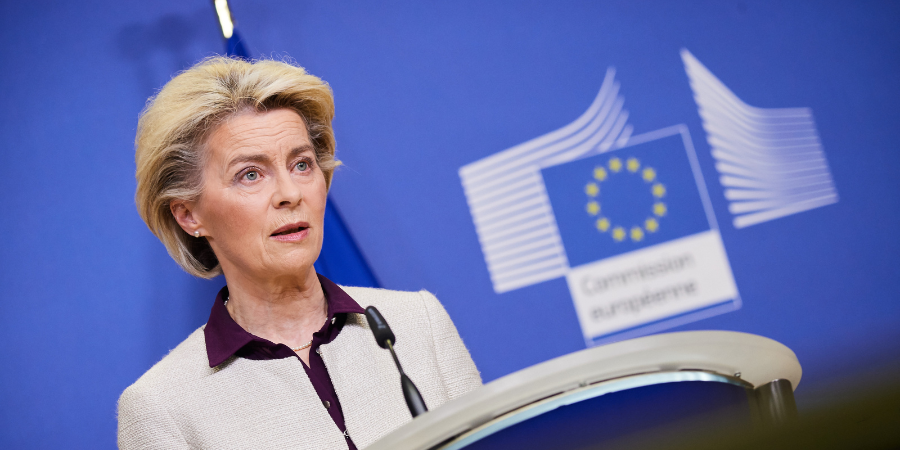
On May the 8th, the Istituto Ciampi hosted the authors of an important book on the von der Leyen Commission (The European Commission under President Ursula von der Leyen: Gender, Leadership, Policies, and Crises, Oxford University Press, 2025) The volume edited by Gabriele Abels (University of Tübingen), Johanna Kantola (University of Helsinki), and Emanuela Lombardo (SNS) and Henriette Mueller (NYU, Abu Dhabi) analyzes the multifaceted role gender has played in von der Leyen’s leadership, the Commission’s agenda-setting and policymaking, and its responses to European crises. The lively discussion involved the editors, other contributors and discussants that brought to the table a wide range of topics and different point of views.
We met the four professors at the end of the conference to discuss their book.
In your book you discuss the ways president von der Leyen has pushed gender issues in a new and more productive way than her predecessors. Putting gender issues on top of the agenda during her first mandate comes after years of women mobilization on the issue of gender violence and other matters. Can we say that this new importance of gender issues was also response to what was happening in European society? I’d also ask, what has happened between VDL and VDL2 when gender issues have become less important or, at least, less visible?
Emanuela Lombardo
During the first von der Leyen Commission we observe a response to opposition against gender equality and a proactive equality agenda. This is also because there was this long-term demand for equality that came from the European Parliament as from the transnational civil society organizations working on equality. So, yes, it was not a “one woman show” about equality it comes from a long-term demand for it.
Gabriele Abels
I would also add that VDL already had a record of pushing for gender equality at the national level already I mean she would think about gender equality, that was already on her agenda as a national minister. Of course, that is also building on decades of women’s rights activism. But nevertheless, with her predecessors, there never was a a gender equality, women’s rights issues in the Commission, never a real strategy, just internal documents. This was certainly a change. Then, there was also the push from progressive movements and the fact that she knew that her nomination was contested and therefore she was reaching out to the political groups whose votes she was depending on with the Green Deal and the gender equality issues.
Johanna Kantola
To this we can add that nowadays something has changed. It is clear that we don’t have the same kind of pressure from the European parliament that was elected in 2024. It’s a centre-right, far-right dominated parliament for the first time while civil society organisations, I think, have been also silenced at the EU level. It’s bad times for the women’s movement and there are a lot of challenges. This is definitely a shift. We also have to understand that that gender equality (in negative terms) is really important for the far right and to the radical right populists who are now stronger in the European Parliament. It is quite difficult under these circumstances to keep it on the agenda. Today is all about competitiveness and Defence. We cannot say, yet, if the reduced push on gender equality issues are less important, the jury is out there. The new gender equality strategy is out, it will need some analysis.
Henriette Muller
For sure the issue is not at the forefront in terms of communication, sometimes strategically. In the book chapter by Agnès Hubert and Sophie Jacquot, the authors write about this strategic de-emphasizing coupled with a work under the radar to push the agenda forward. This might be a good strategy but at the same time it undermines the very things that you want to push forward, as it makes it much easier to sideline them or to roll them back. So they are, it’s a trade-off and there are great risks to it. And, building off on what Johanna just said with regard to the European Parliament, I think the same applies also to the European Council, where we see many more governments on the conservative side. Same with the composition of the commission. These power balances are very important to consider in terms of which agenda you can propose and push forward.
Gabriele Abels
But I think we all would agree that if Manfred Weber, the leader of the EPP in the European Parliament who was also a candidate, had become the Commission President, we wouldn’t need to talk about the union of equality, because that wouldn’t be on the table at all.
What is the importance of the president’s commitment to this shift towards more attention to gender issues?
Gabriele Abels
Well, the commitment is certainly there because we have seen over the last 20 years that the role of the Commission President has changed, becoming more important, representing the Commission, having the role of setting the agenda, putting issues here forward, organizing the Commission in terms of the College of Commissioners, assigning who should take which portfolios or coming up with new ones. And in that sense, it was very important that she introduced the equality commissioner for the first time ever. In VDL2 there is some downgrading, because the same commissioner has in its portfolio Preparedness and Crisis Management.
And how would you explain this shift? Just the political climate? Isn’t it true that if you are committed to a policy issue you would keep it central in the agenda? Was it more important to be re-elected? One could argue, she watched at the political landscape and decided that it was clever to make a step back on gender equality.
Johanna Kantola
We mentioned political context, but I would also think that even if equality or the Green Deal were important to her, she’s probably got other agendas as well. The book shows how she took a really active role in relation to COVID and the Russian aggression war in Ukraine. I’m just speculating here, but I think it’s important to kind of realize that it’s not that she wants to stay as a Commission president for nothing, she probably still feels that there are agendas that she can further and she believes in these other agendas. This is a big speculation, but I think it’s important to stress that she was a crisis leader and she was a leader in relation to very many fields. I think she genuinely believes in the preparedness union, for example, like preparing the EU for Russian attack. There is a broad agenda, often generated by crisis, but she can still also work on those issues that were critical during the first mandate.
Henriette Muller
We should also take into account the institutional and political context. If you’re in the national context, you usually are the candidate of a party, let’s say, that you have a certain manifesto that you pursue and you get elected or not. But here, of course, while she is a candidate from the EPP and she needed to convince also the parliament anew. So, there is a demand to always move across the political aisle, to bring in very different agenda items and perspectives. And, as we said, the political context has changed, shifting to the right, which explains this shifting agenda that you observe.
Gabriele Abels
I would also like to add, that the pressure from the German government side, from the new Chancellor, has increased enormously. Merz has been pressing on the combustion engine issue in very strong terms, same for Manfred Weber. I mean she can’t expect to be protected from Macron any longer because Macron and some of the other stronger countries have their own agenda (Meloni or the conservative government in Poland).
How much does the opposition to gender policies weigh on and influence the European Union’s choices? Did things change between VDL 1 and 2?
Emanuela Lombardo
So, the first VDL Commission, had a very proactive policy in relation to equality, not just gender equality, but also LGBTIQ equality, anti-racism. There was a broad institutionalization of equality: the first equality commissioner, the first anti-racism coordinator. In this respect, there was really a push for equality and also the response to the opposition against it on the part of the far right was very strong, through discourse, through policy making and also through infringement procedures and economic sanctions. We see now there is a shift. There was a downgrading of the institutionalization of equality. As Gaby was saying before there’s no longer a commissioner on equality, and also the position of the anti-racism coordinator has been downgraded. This also has an impact on the policies that have been dropped from the agenda: the anti-discrimination directive, for example, is not on the agenda any longer.
To end with a little bit of hope, we have to think that some of the policies that von der Leyen put in place in the first commission, still will have some long-term effects. There was this unprecedented ruling by the Court of Justice on the issue of fundamental rights and the sentence against the Hungarian government for state’s institutional homophobia, which was really a pioneering use of the Article 2 on values and fundamental rights. But of course, the context is more hostile. As we were saying before, von der Leyen is responding to these different voices and adapting in this way.
Let’s talk about the leadership style. The feminist critic of a masculine way of exercising leadership, I would say, clashes with the assertive, centralizing, way she has governed. It is not just women in power, but also the way power is practiced, isn’t it?
Henriette Muller
A chapter in the book compares different commissions, all the way back to Prodi – Prodi, Barroso one and two, Juncker and von der Leyen – and it shows that she tends to be a little more collegial, I believe, sharing leadership roles, for example. We can clearly see differences in how women lead across very different institutions and how they might also shift policy focus. At the same time, as was highlighted before by Johanna Kantola and everyone, basically there are institutional constraints to this. When we think from a feminist institutionalist perspective, feminist institutionalism highlights the long masculine legacies, actually, and often argues also that change might be very incremental, or that it’s not sufficient to only look at the descriptive side. Okay, with women leaders, let’s say, we check all boxes, but the institutional structures are still in place.