
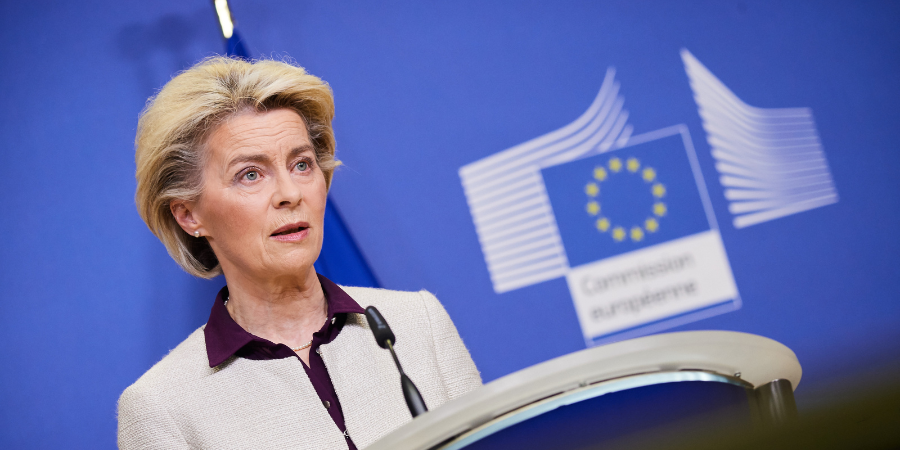
On May 8, the Ciampi Institute hosted a conference discussing the von der Leyen Commission from a gender perspective. The discussion was based on the edited volume by Gabriele Abels (University of Tübingen), Johanna Kantola (University of Helsinki), Emanuela Lombardo (Scuola Normale Superiore), and Henriette Mueller (NYU Abu Dhabi), The European Commission under President Ursula von der Leyen: Gender, Leadership, Policies, and Crises (Oxford University Press, 2025).
We interviewed the editors of the volume here, but it also seemed useful to provide a brief account of the discussion, particularly highlighting some critical perspectives concerning the loss of centrality of gender issues in the transition from President von der Leyen’s first to her second term, as well as the ways in which gender is either largely absent from—or addressed in problematic ways within—migration policies.
What follows is a very concise summary of the presentations.
Gabriele Abels
The questions to be addressed are: What impact has having a female president had on agenda-setting? How has the Commission changed? Are the innovations introduced in the field of equality likely to have a lasting impact?
Von der Leyen’s candidacy came as a surprise, and her first presidency had to confront an unprecedented series of crises (Brexit, COVID-19, Ukraine). One of the major achievements in terms of gender equality policies has been to make the issue mainstream. During her presidency, organizational changes were introduced, gender equality was placed on the agenda, and legislation that had been awaiting adoption for years was finally enacted.
Johanna Kantola
How and to what extent has von der Leyen’s work shaped European institutions by introducing gender equality issues and exercising leadership? And to what extent have institutional dynamics acted as a constraint?
Under von der Leyen’s presidency, the Commission experienced a relative decline in influence as the roles of the European Parliament and the European Council expanded. The election of Charles Michel as President of the European Council created an unequal dynamic, with the Council showing limited attention to gender issues. Nevertheless, von der Leyen played an important role in fostering cooperation among institutions and in advancing the Pay Transparency Directive adopted in 2024.
Henriette Mueller
What kind of leadership is needed in times of crisis? The president’s role involves proposing, facilitating, and providing symbolic leadership. This was evident both in responding to crises and in establishing an EU equality agenda that represents the most comprehensive response to anti-gender and anti-LGBTIQ movements in Europe to date.
In times of crisis, an assertive female leader faces a higher risk of failure because leadership norms remain masculinized. An analysis of von der Leyen’s speeches during her first mandate (2019–2023) shows that she was able to frame issues effectively, demonstrated strong and adaptive leadership in response to crises such as Ukraine and COVID-19, and succeeded in expanding the role of the presidency. However, the crises themselves tended to sideline and compartmentalize the equality agenda.
Hussein Kassim
Gender equality was addressed relatively late by successive Commissions. However, a careful analysis of leadership and management data shows a growing presence of women, with women reaching 50% representation in middle management positions. This trend developed over time but accelerated during von der Leyen’s first term.
At the same time, women continue to face greater difficulties in advancing their careers and achieving senior positions. Progress in gender equality remains fragile and highly dependent on the political context. In this regard, signs of regression have emerged during the second mandate. This suggests that improving numerical representation alone is insufficient and that a broader cultural transformation is required.
Emanuela Lombardo
Opposition to gender equality and LGBT rights already existed in the form of lobbying, public debate, mobilization, and measures such as Lithuania’s anti-gay propaganda law. However, the Commission’s response only began under von der Leyen’s presidency.
Her first mandate was characterized by an ambitious agenda, including initiatives such as the directive on combating violence against women, alongside other proposals that ultimately failed to materialize. For the first time, Article 2 of the Treaty was invoked to sanction Poland and Hungary, unprecedented actions that demonstrated the use of all available presidential tools.
Some of these choices reflected a progressive European context, while others were made possible by the support of social-democratic forces necessary to build a parliamentary majority. Nonetheless, a gap remains between announcements and implementation. For example, Hungary was sanctioned over homophobia, yet EU funds were later released as part of negotiations concerning Ukraine’s accession process.
Jane Freedman
Gender equality is not integrated into migration and asylum policies. In the 2024 Migration Pact, gender is framed mainly through the lens of protecting vulnerable groups—essentially women.
More broadly, since 1999 the EU has increasingly treated migration as a security issue, implementing ever more coercive forms of border protection and restricting migrants’ rights. In contrast with the EU’s gender equality and LGBTIQ strategies, gender is almost absent from the Commission’s communication on the Pact, except in relation to human trafficking.
Gender issues instead appear within anti-immigration discourse, for example through narratives portraying “Muslim men” as a threat to women. Gender equality and LGBTIQ concerns are largely absent from the Commission’s communication on the Pact, except in relation to trafficking, and are mentioned only minimally in speeches and official statements.
There is also a contradiction between the rhetoric suggesting that most asylum seekers do not require protection and the simultaneous emphasis on attracting highly skilled labour. Finally, the Ukrainian crisis has contributed to the racialization of migrants, creating distinctions between people fleeing who are perceived as “like us” and all others.
Anna Elomäki
One of the ambitious goals of the first von der Leyen Commission was “An Economy that Works for People,” a goal that in some respects continued trends from the Juncker years. The key questions are: how much did social policies change, and what role did gender equality play within them?
Traditionally, the EU has prioritized market-making over market-correcting policies. Despite rhetorical shifts and the introduction of new social governance tools, there has been no fundamental rebalancing of social and economic objectives in economic governance and policymaking.
Was this partial shift the result of von der Leyen’s agency as a critical actor, or of the social and political environment of her first mandate? The initial steps of her second term suggest a change in direction: competitiveness has become a central priority, while the discourse on an “economy that works for people” has largely disappeared, and very little new social legislation is planned.